

Minister for Power, Energy and Mineral Resources, Iqbal Hasan Mahmud Tuku, has said that the load-shedding situation is expected to improve somewhat within the next few weeks, as efforts are underway to gradually overcome the ongoing crisis.
He made these remarks on Monday while speaking as the chief guest at the “Bangladesh-China Renewable Energy Forum” organized by the Centre for Policy Dialogue (CPD).
The minister noted that outstanding payments to private power producers, a shortage of foreign currency, and the high cost of fuel imports have made the current situation more complex. He added that past policy mistakes and the burden of unnecessary projects are still affecting the sector.
Highlighting that the cost of oil imports has increased by $2 billion, he said that the power sector still has outstanding dues amounting to Tk 56,000 crore.
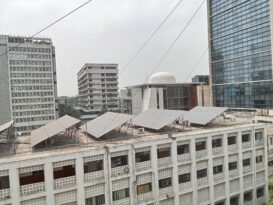
Iqbal Hasan further stated that solar power is the most effective and sustainable solution to address the country’s electricity crisis. The government has set a target to generate 10,000 MW of solar power over the next five years. Initiatives have been taken to make unused government land available to investors. Through inter-ministerial coordination, vacant land under various agencies will be identified and used for large-scale solar projects. Government-owned land created by erosion along the Jamuna River will also be included under this plan.
He added that large amounts of unused land under institutions such as Bangladesh Railway will be brought under investment. A committee has already been formed to implement large projects under public-private partnership (PPP) arrangements.
Chinese Ambassador to Bangladesh Yao Wen, along with investors from different countries and government officials, attended the event.
Executive Chairman of the Bangladesh Investment Development Authority (BIDA), Chowdhury Ashik Mahmud Bin Harun, said that land scarcity has long been a major obstacle to expanding solar power. To address this, a new guideline has been formulated, allowing private investors to use government land for 15 to 20 years.
He informed that the first pilot project has already begun in Sonagazi, Feni. At the same time, a list of unused land under various ministries will be prepared and opened up to investors. Government participation will make bank financing easier and enable the rapid implementation of large-scale projects exceeding 50 MW capacity. Additionally, the government is considering providing duty benefits for battery storage technology.
CPD Research Director Dr. Khondaker Golam Moazzem said that the global economy, heavily dependent on fossil fuels, is becoming increasingly uncertain. Rising oil prices in the international market negatively impact the country’s economy and inflation. Therefore, there is no alternative to renewable energy for ensuring energy security.
He noted that achieving the target of 10,000 MW of environmentally friendly power generation by 2030 would require more than $9 billion in investment.
Due to structural weaknesses in existing contracts and the recent cancellation of 31 solar projects, investor confidence has been shaken, putting around $6 billion in potential investment at risk.