

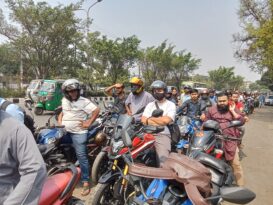
The suffering over fuel oil has yet to ease. Long queues are still visible at filling stations, with people having to wait for extended periods to get fuel.Fearing shortages, many are buying more fuel than usual.
Visits to various filling stations in the capital revealed this situation.
Minister for Power, Energy and Mineral Resources, Iqbal Hasan Mahmud, said that there is no shortage of fuel in the country and that supply has been increased by 25 percent. Speaking to journalists at his residence on Tuesday, the minister stated that fuel supply is 25 percent higher than last year and urged the public not to panic.
Despite reduced traffic in the capital during the Eid holidays, the suffering related to fuel has not subsided. People across the country, including in the capital, are facing difficulties amid the festive period. Long queues of private cars and motorcycles have been observed, with many having to wait two to three hours. Some filling stations are not operating properly. Consumers have demanded initiatives to reduce the hardship.
Filling station owners have also alleged that they are not receiving fuel from depots according to demand.
The Bangladesh Petroleum Dealers, Distributors Agents, and Rajshahi Division Petrol Pump Owners Association have demanded that petrol and octane be supplied from depots according to tanker truck capacity. In a letter submitted to the Bogura offices of Padma, Meghna, and Jamuna companies, they raised this demand.
The letter stated that recently, petrol and octane supplied from various depots, including the Baghabari depot, often do not match the calibrated capacity of tanker trucks. As a result, petrol pump owners are facing financial losses. Typically, each chamber of a tanker truck has a capacity of 4,500 liters. However, in many cases, only 2,000 to 3,000 liters of petrol and octane are being supplied. This increases transportation costs from depots to pumps, putting additional financial pressure on pump owners.
On the other hand, if pump owners refuse to lift fuel under such conditions, the fuel is being distributed through various agencies. There are concerns that this may lead to fuel being diverted to the black market, potentially causing instability and price hikes in the fuel market in the future.