
All restrictions on the sale of fuel to consumers and supply at filling stations have been withdrawn. From now on, consumers will be able to purchase fuel according to their needs.
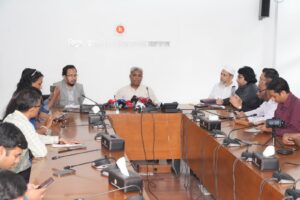
State Minister for Power, Energy and Mineral Resources Anindya Islam Amit informed journalists about the decision at the Secretariat on Sunday.
Until further notice, diesel, petrol and octane can be supplied and sold normally according to demand at all filling stations across the country.
The State Minister said that all restrictions related to fuel distribution have been lifted. He explained that the decision was taken for three reasons: to ensure smooth travel during the upcoming Eid holidays, to maintain uninterrupted irrigation for the agricultural sector, and because several fuel tankers have already arrived at Chattogram port.
Responding to a question, the State Minister said fuel prices will not be increased as long as the economy can withstand the current pressure.
He added that the government is taking maximum initiatives to ensure that there is no shortage during the ongoing Boro irrigation season. Discussions are also underway with neighboring countries. Talks are also being held on whether Russian oil can be imported through third countries.
According to a statement issued by the Energy and Mineral Resources Division, the government had taken several measures to manage the situation as disruptions in the global fuel supply chain emerged due to the Iran–Israel conflict. Several fuel tankers that were previously imported have already reached Chattogram port.
In this context, the government has decided to withdraw rationing and all other restrictions on fuel distribution in order to ensure smooth Eid travel for the public and uninterrupted irrigation activities for farmers during the Boro season. The statement added that from March 15, fuel will continue to be supplied at all distribution points across the country according to demand.
On March 6, the government imposed limits on fuel sales across the country. At that time, daily limits were set at two liters for motorcycles, 20–25 liters for private cars or microbuses, 70–80 liters for pickups and local buses, and 200–220 liters for long-distance buses, trucks and covered vans.
After the limits were introduced, a significant fuel shortage emerged, with long queues forming at filling stations.
Later, the limit for ride-sharing motorcycles was increased from two liters to five liters, and the rationing quota for filling stations was reduced from 25 percent to 15 percent.
Dhaka Wednesday, Jul 15, 2026
- Government Begins Talks with IMF for a New Loan Program
- Power Division Opens Control Room to Address Flood Situation
- It Will Take Time to Break Free from the Cycle of Corruption in the Power Sector: Information Minister
- Electricity Prices Increased for All Consumers
- Approval Given to Purchase Three LNG Cargoes
- Diesel, Kerosene Prices Cut By 50p For November
- AI Boom To Fuel Natural Gas Demand In Coming Years, Report Says
- Bangladesh signs €477m deals with EU and EIB for renewable energy and more
- The Current Oil Price Rally Is Reaching Its Limits

March 15, 2026
All Restrictions on Fuel Sales Withdrawn
Staff Correspondent, Dhaka (Sunday, March 15, 2026)
Commenting is closed here