

Under the latest decision of the Bangladesh Energy Regulatory Commission (BERC), electricity tariffs have been increased for all categories of consumers, including residential, agricultural, industrial, commercial, and other users. The price hike is expected to further increase monthly expenses for consumers already struggling with inflation.
According to the new tariff schedule, electricity prices have increased by between 69 poisha and Tk 3.64 per unit, depending on the consumer category. As a result, monthly electricity bills will rise significantly based on the amount of electricity consumed.
How Much More Will Residential Consumers Pay?
Although low-consumption households will face a relatively smaller increase in monthly expenses, medium and high-consumption users will experience a much greater financial burden. Consumers who use fewer units will naturally pay less.
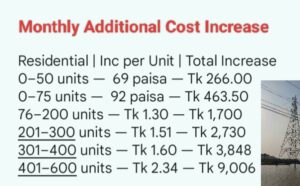
For consumers using up to 50 units, the tariff has increased by 69 poisha per unit, meaning their maximum additional monthly expense will be Tk 34.50 (50 × Tk 0.69). Their total monthly bill will be approximately Tk 266.
Similarly, consumers using up to 75 units will pay an additional Tk 69 per month due to the 92-poisha increase per unit, bringing their total bill to Tk 463.50.
The largest group of residential consumers falls within the 76–200 units, 201–300 units, and 301–400 units consumption brackets.
A household consuming 200 units per month will pay approximately Tk 260 more than before, with a total bill of Tk 1,700.
Consumers using 400 units will pay an additional Tk 640, bringing their monthly bill to Tk 3,848.
A household consuming 600 units will face an additional cost of Tk 1,404, resulting in a monthly bill of Tk 9,006.
Amid persistent inflation, the increase in electricity prices is expected to further raise household expenses. Fixed-income middle-class and lower-middle-class families are likely to be particularly affected. Moreover, higher electricity costs will increase production costs for various goods and services, adding further pressure to the overall cost of living.
Impact on the Agricultural Sector:
The electricity tariff for irrigation and agricultural use has increased by 79 poisha per unit.
A consumer using 1,000 units per month will pay an additional Tk 790.
A consumer using 5,000 units per month will pay an additional Tk 3,950.
As irrigation costs rise, agricultural production expenses are also expected to increase.
Additional Burden on Small Industries
For small industrial consumers:
Flat-rate tariff: increased by Tk 1.97 per unit
Off-peak tariff: increased by Tk 1.77 per unit
Peak-hour tariff: increased by Tk 2.32 per unit
A small industrial facility consuming 5,000 units per month may incur an additional electricity cost ranging from Tk 8,850 to Tk 11,600, depending on usage patterns.
Highest Impact on the Construction Sector
Electricity used for construction activities has become Tk 2.94 more expensive per unit.
Additional cost for 1,000 units: Tk 2,940
Additional cost for 5,000 units: Tk 14,700
This increase is expected to push construction costs even higher.
Impact on Educational Institutions, Hospitals and Religious Establishments
The tariff for educational institutions, hospitals, and religious establishments has increased by Tk 1.50 per unit.
Additional cost for 1,000 units: Tk 1,500
Additional cost for 10,000 units: Tk 15,000
Electricity tariffs for street lighting and water pumping have increased by Tk 1.75 per unit, raising operating costs for city corporations, municipalities, and WASA. These higher costs may eventually be reflected in public service charges.
Electric vehicle (EV) charging stations will also face increased electricity costs, leading to higher charging expenses.
Impact on Commercial Consumers
A commercial establishment consuming 10,000 units of electricity per month will incur an additional cost ranging from Tk 21,100 to Tk 28,100, depending on the applicable tariff category.
Largest Increase for Temporary Connections:
Temporary electricity connections have experienced the highest tariff increase among all categories, rising by Tk 3.64 per unit. Additional cost for 1,000 units: Tk 3,640, Additional cost for 5,000 units: Tk 18,200.
Overall Assessment:
The new electricity tariff will increase costs across all sectors, including residential, agricultural, industrial, commercial, and service-related consumers. Combined with the recent increase in fuel prices, the decision is expected to put additional pressure on transportation, agricultural production, industrial output, and the prices of essential goods.
For fixed-income households in particular, the rise in electricity prices will further increase monthly living expenses, creating growing concerns about maintaining a sustainable standard of living.