
The Ministry of Commerce has set an export target of US$63.4 billion for the fiscal year 2026-27. Of the total, US$55.2 billion is expected to come from merchandise exports, while US$8.2 billion is projected from services exports. The government has set a 15 percent growth target for both sectors.
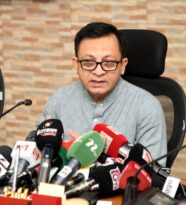
Announcing the target at a press briefing at the Ministry of Commerce, Commerce Minister Khandaker Abdul Muqtadir said that despite global economic uncertainty, ongoing geopolitical tensions and challenges in international markets, Bangladesh’s export sector has a realistic opportunity to rebound. He said the government is working to create a more business-friendly environment, facilitate investment and simplify public service procedures to accelerate export growth.
Commerce Secretary Md. Ataur Rahman Khan, Export Promotion Bureau (EPB) Vice Chairman Mohammad Hasan Arif, and other officials were present at the briefing.
The minister said negotiations on Free Trade Agreements (FTAs) with South Korea and the United Arab Emirates are in their final stages. Bangladesh also aims to conclude FTAs with several other countries within this year. He expressed hope that formal negotiations on an FTA with the European Union would begin soon.
Emphasising export diversification, the minister noted that around 85 percent of Bangladesh’s total exports currently come from the ready-made garment (RMG) sector. To reduce this dependence, the government is giving special priority to the leather and leather goods, footwear, shipbuilding, ship recycling, light engineering and information technology (IT) sectors. Specific action plans to develop these industries will be implemented soon, he added.
Regarding the United States’ tariff policy, the minister said there has been no effective change in the tariff structure applicable to Bangladesh. The existing 10 percent tariff remains in force under the new legal framework, and therefore no additional adverse impact on the country’s exports is expected.
On the energy situation, he said that due to limited gas supply, the industrial sector has yet to fully utilise its production capacity. The government is working to improve the situation by installing additional Floating Storage and Regasification Units (FSRUs) for LNG imports.
The minister expressed confidence that Bangladesh would be able to achieve the export target for the next fiscal year, citing policy stability under the elected government, business-friendly reforms, new free trade agreements and growing confidence among international buyers.
He further said that Bangladesh now stands at the threshold of new opportunities. Through coordinated efforts to improve the ease of doing business, expand access to new markets and diversify exports, the country aims to usher in a new phase of export growth.
Dhaka Monday, Jul 27, 2026
- Export Target Set at US$63.4 Billion for FY2026-27
- 10-Member Wildlife Commission Formed to Protect Wild Animals
- LNG Floating Terminal Fault More Complex; Repair Timeline Remains Uncertain
- Electricity Prices Increased for All Consumers
- Approval Given to Purchase Three LNG Cargoes
- Diesel, Kerosene Prices Cut By 50p For November
- AI Boom To Fuel Natural Gas Demand In Coming Years, Report Says
- Bangladesh signs €477m deals with EU and EIB for renewable energy and more
- The Current Oil Price Rally Is Reaching Its Limits

July 26, 2026
Export Target Set at US$63.4 Billion for FY2026-27
Staff Correspondent, Dhaka (Sunday, July 26, 2026)
Commenting is closed here