

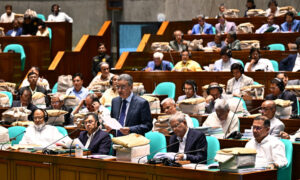
Finance Minister Amir Khosru Mahmud Chowdhury today unveiled a record Tk 9.38 lakh crore national budget for the FY27 outlining the BNP government’s comprehensive roadmap to shape a human economy.
“The government is rolling out the budget aiming at restoring macroeconomic stability, accelerating investment and employments, expanding social protection and steering Bangladesh towards becoming a one-trillion-dollar economy by 2034,” said the minister.
This was the maiden budget for the Finance Minister after BNP formed the government this time following a landslide victory on February 12 general election. A BNP-led government had last presented its national budget for the fiscal year 2006-’07 under then Finance Minister M. Saifur Rahman.
Placing the budget in the Jatiya Sangsad today during the second session of the 13th Parliament, the finance minister wearing a nice suit in his 234-page budget speech under the title “Journey Towards a Democratic, Humane and Inclusive Economy”, emphasized on economic democratization, equitable distribution of opportunities and broad-based participation in national development. Leader of the House and Prime Minister Tarique Rahman was present at the House.
Speaker Hafiz Uddin Ahmad, Bir Bikram, presided over the parliamentary sitting as the finance minister delivered his budget speech, setting out the government’s strategy for economic recovery and long-term transformation.
“The budget has been formulated with a focus on economic stability, investment, production, employment generation, and the establishment of an equitable society,” Amir Khosru told parliament.
He said the central philosophy of the budget is “to achieve stable economic growth owing to the welfare of the people through economic democratization and transform Bangladesh into a one-trillion-dollar economy by 2034.”
Budget framed amid economic challenges:
The FY27 budget comes at a time when Bangladesh is grappling with multiple economic challenges, including persistent inflationary pressures, a widening revenue shortfall, rising debt-servicing costs and weaknesses in the banking sector.
The National Board of Revenue (NBR) reportedly fell more than Tk 1 lakh crore short of its revenue target by April of the outgoing fiscal year, while non-performing loans in the banking sector rose to over 30 percent by the end of December 2025.
Global uncertainties have also added pressure on the economy.
The recent closure of the Strait of Hormuz amid wider Middle East tensions has significantly increased energy import costs, placing additional strain on the country’s external sector and fiscal management.
Against this backdrop, the government has sought to balance fiscal prudence with growth-oriented expenditure and social investments.
Major macroeconomic targets:
The government has projected the size of the economy at Tk 68.30 lakh crore for FY27 and set ambitious macroeconomic targets aimed at restoring confidence and stimulating growth.
The budget targets:
GDP growth: 6.5 percent; Inflation: 7.5 percent; Budget size: Tk 9.38 lakh crore; Revenue collection: Tk 6.95 lakh crore; Budget deficit: Tk 2.43 lakh crore; Deficit-to-GDP ratio: 3.6 percent.
The proposed budget size is around 19 percent larger than the original Tk 7.90 lakh crore budget for FY26 and amounts to approximately 13.7 percent of the country’s projected GDP.
Khosru said the government’s primary objective is to stabilize the economy while creating the conditions necessary for higher growth, investment and employment generation.
“These targets are designed to ensure stability, enhance purchasing power, and improve living standards,” he said.
Ten strategic priorities:
The finance minister said the FY27 budget has been framed around ten strategic priorities designed to accelerate growth while ensuring social justice and inclusion.
The first two priorities are “Development for All” and “Quality Education and Healthcare for All”, reflecting the government’s emphasis on human capital development.
Other priorities include employment generation, private-sector-led investment, social protection, energy security, infrastructure development, technological advancement and institutional reforms aimed at improving governance and public service delivery.
According to budget documents, the government intends to build a discrimination-free economy by ensuring fair participation and partnership among all sections of society, economic sectors and regions.
3R strategy for economic revival:
A major feature of the budget is the announcement of a comprehensive 3R Strategy to revive the economy and place Bangladesh on a higher growth trajectory.
The strategy consists of: Recovery and Stabilisation; Restoration; Reconstruction for Acceleration. The government plans to implement the strategy in phases over a one-to-five-year period.
Explaining the long-term vision, the finance minister said: “Going forward, we aim to transform Bangladesh into a one-trillion-dollar economy by 2034, driven by investment, productivity and job creation.”
He further said the government seeks to democratize economic opportunities across society so that the country’s demographic strength and increasing life expectancy can be transformed into what he termed a “Democratic Dividend.”
Revenue mobilization challenge:
To finance the ambitious expenditure programme, the government has set a revenue collection target of Tk 6.95 lakh crore, equivalent to 10.2 percent of GDP.
Of this amount, the NBR has been assigned a target of Tk 6.04 lakh crore, accounting for approximately 8.84 percent of GDP. Additional revenues are expected from non-NBR taxes and non-tax sources.
The finance minister acknowledged the need for major improvements in revenue administration and tax compliance.
He noted that during the previous government’s tenure, the tax-to-GDP ratio had fallen below seven percent and emphasized that the current administration intends to reverse that trend through reforms and modernization.
“Over the medium term, efforts will be made to accelerate revenue mobilization, maintain the budget deficit at a manageable level, restore discipline in debt management, and improve the country’s credit rating from a medium-risk to a low-risk category,” he said.
Deficit financing and debt management:
The proposed budget estimates an overall deficit of Tk 2.43 lakh crore, equivalent to 3.6 percent of GDP.
The government plans to finance the deficit through a combination of foreign borrowing, domestic borrowing and external grants.
According to budget documents, foreign financing will play a major role in deficit management, while domestic financing will include borrowing from the banking sector and national savings instruments.
The government has also allocated Tk 1.27 lakh crore for interest payments on domestic and foreign loans, highlighting the growing burden of debt servicing on public finances.
However, Khosru emphasized that the government remains committed to keeping debt-related risks within sustainable limits.
“The budget deficit target has been set at 3.6 percent of GDP, which will help keep debt-related risks within a sustainable range,” he said.
Greater emphasis on private-sector growth:
The finance minister announced a shift away from debt-driven economic expansion toward a growth model centered on investment, productivity and employment.
“The Government will pursue a transition away from debt-driven growth toward an economy centered on production, employment, and private sector investment,” he said.
To facilitate private investment, the government plans to gradually reduce its borrowing from the banking system and strengthen alternative financing channels.
The budget speech highlighted plans to diversify the country’s financial markets through the development of corporate bonds and municipal bonds, while also simplifying business regulations and licensing procedures.
Measures to modernize tax administration, expand digital public services and improve the ease of doing business were also announced as part of the government’s investment promotion strategy.
Historic increases in education and health allocations:
Human capital development emerged as one of the central pillars of the FY27 budget.
The allocation for the education sector has been increased significantly while the allocation covers not only institutions under the Ministry of Education and the Ministry of Primary and Mass Education but also educational and technical institutions managed by other ministries and agencies.
Similarly, healthcare has received a significant boost, with total allocations rising to Tk 69,409 crore, equivalent to 1.01 percent of GDP, compared with only 0.58 percent of GDP in the outgoing fiscal year.
The government has announced plans to gradually raise spending on both education and health to 5 percent of GDP over the coming years.
Expanding social protection:
Recognizing the importance of protecting vulnerable populations from economic hardship, the government has pledged to expand social protection programmes.
The finance minister highlighted initiatives introduced shortly after the government assumed office, including the Family Card, Farmer Card and honorarium programmes for individuals serving in mosques and other places of worship.
These programmes will be expanded in FY27 alongside existing safety-net initiatives to promote dignity, inclusion and equitable development.
Development priorities:
The government has proposed Tk 3,16,075 crore in development expenditure, including allocations under the Annual Development Programme (ADP) and other development projects.
Priority sectors include agriculture, energy security, information and communication technology, transport infrastructure and employment generation.
The finance minister also announced plans to bring the Creative Economy, Sports Economy, Green Economy and Blue Economy into the mainstream of national development planning.
Criticism of previous economic management:
In one of the most politically significant portions of his speech, Khosru sharply criticized the economic management of the previous regime.
“During fascist rule, economic policy and planning were often shaped by narrow interests rather than national priorities,” he said.
He alleged that corruption, systemic inefficiencies and the concentration of wealth among a small group weakened the country’s economic foundations while concealing underlying macroeconomic vulnerabilities.
“The economic engine, the primary driver of nation-building, was progressively weakened over more than fifteen years,” he added.
Call for national unity:
Concluding his budget speech, the finance minister called on all sections of society to work together in implementing the government’s reform agenda.
“I seek the cooperation of the members of this National Parliament, as well as of our farmers, workers, students, women, youth, entrepreneurs, professionals, expatriates, and citizens from all walks of life,” he said.
Reaffirming the government’s commitment to shared prosperity, Khosru declared: “Our commitment is to build a Bangladesh where equal opportunities are available to all, where enterprise and innovation are encouraged, where the rewards of hard work are ensured, and where the benefits of economic progress are shared by every citizen.”
He concluded with a vision of an inclusive future, saying: “We envision a prosperous future where the pride of a transformed Bangladesh belongs to all.”