

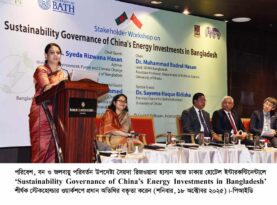
Syeda Rizwana Hasan, Adviser to the Ministry of Environment, Forest and Climate Change and the Ministry of Water Resources, has said that all government institutions will be brought under renewable energy within the next two to three years. She emphasized that government agencies themselves must take the lead in the country’s transition to renewable energy.
She made these remarks while speaking as the chief guest at the opening session of the international conference “Road to COP30: How Can National Interests Be Aligned with Global Climate Goals?” held at the BRAC Center Inn in Dhaka. The theme of the conference was “A World Beyond Crisis: Climate Solutions That Work.”
Emphasizing sustainable consumption and production, she called for the adoption of environmentally friendly strategies across all sectors.
The adviser said that the Department of Environment, with the support of the World Bank, is constructing eco-friendly office buildings in different regions and developing models of energy-efficient, green buildings in collaboration with architects and engineers. She also noted that technology transfer alone would not solve the problem.
Rizwana Hasan observed that double-counting in climate finance and weak global governance systems have eroded trust and hindered the flow of adaptation support.
She stated that Bangladesh must remain proactive in safeguarding its national interests, economic activities, and people’s livelihoods. She praised the government’s updated Nationally Determined Contributions (NDCs), which reflect the participation and ownership of all relevant ministries and agencies.
The adviser instructed the Department of Environment to formulate a comprehensive action plan—with specific timelines—for reducing emissions in sectors such as transport, agriculture, and industry.
Under the newly established Bangladesh Climate Development Partnership (BCDP), four working groups have been formed, with instructions to include representatives from civil society and academia to provide technical and policy support.
Referring to the environmental damage caused by brick kilns, Rizwana Hasan urged the use of alternative construction materials that would reduce carbon emissions, protect agricultural land, and prevent hill cutting. She also suggested using dredged river silt instead of fertile topsoil for brick production.
Highlighting the importance of adaptation measures, she stressed that coastal afforestation, rainwater harvesting, and low-cost salinity removal technologies are essential to enhance the resilience of climate-vulnerable coastal areas. She called on development partners to increase financial and technological assistance to implement local solutions in Bangladesh.
The discussion was chaired by Khushi Kabir, a member of the Board of Trustees of the Centre for Policy Dialogue (CPD). Environmental expert Dr. Ainun Nishat and representatives of development partners were also present.